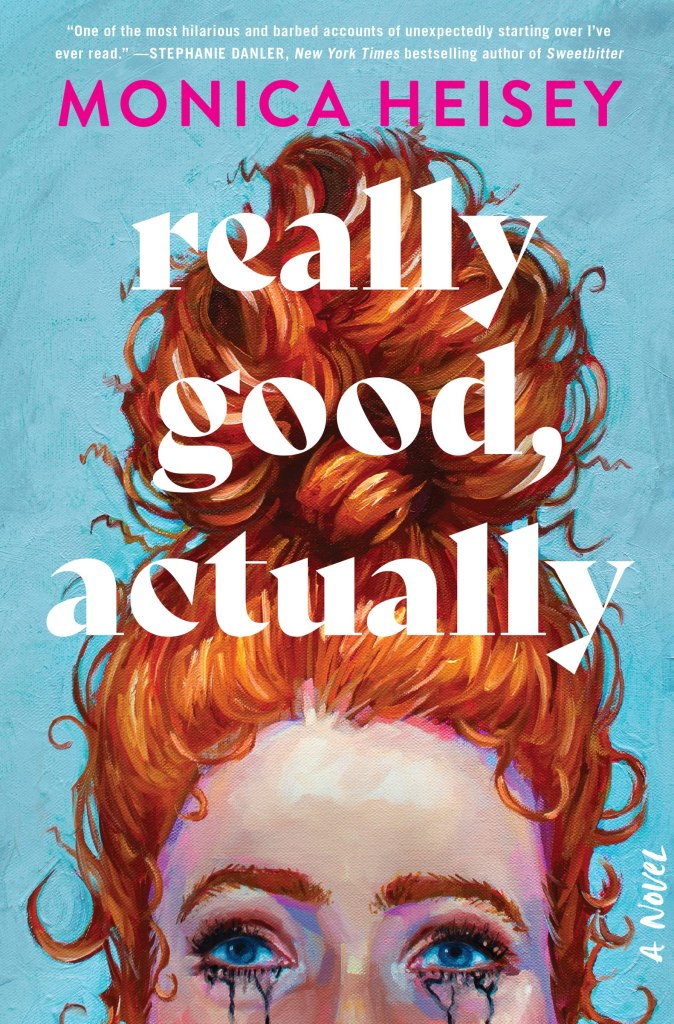
Over the course of the last few days, I listened to yet another audiobook by my favorite narrator, Julia Whelan. I learned about this book a few months back, when my Creative Writing professor told me she was listening to it at the time, and that the cover looked like me. She also declared that the protagonist and I had very little else in common, which now makes me giggle.
Set in Toronto, Canada, Really Good, Actually follows Maggie, a woman newly separated from her husband, after they unexpectedly agreed on getting a divorce. Maggie’s life begins to fall into disrepair, but she continues to project that she is entirely fine. In fact, she’d be the first to tell you that she’s doing amazing! Really good, actually– just like the title, how perfect!
First things first, if you’re the type of person who does not think that listening to audiobooks counts as reading, you’re on the wrong website. Sorry, not sorry! And, with that out of the way, I will confess to you all that I tend to miss a few details when I do listen to audiobooks– but that’s not because of the form, it’s because of my crippling ADHD. Despite my helpful Strattera prescription, I sometimes miss a word or two. When I’m physically reading a book, this happens way more frequently, but I can more easily skim back. Using Audible, I tend to only rewind when the words my brain skipped over seem to have been crucial– which is seldom, because I’m good at context clues– because it’s either thirty seconds or you have to adjust the time yourself.
In the case of Maggie’s story, as with all other stories narrated by Julia Whelan, these instances were few and far between. Mainly, I just found myself confused between two co-workers, Amy and Olivia, for half a second, before I eventually realized that Olivia barely matters to the overarching story. Granted, this could also be a result of the fact that I read approximately five books at one time and also watch a lot of movies and TV, so sometimes details get lost in the folds of my little brain. So, now that I’ve written two full paragraphs of disclaimers– we can continue.
Maggie is a twenty nine year old PhD student in English– I think, but this is one of those details that I didn’t fully get, and one of Maggie’s friends joked about not understanding her job either, so I don’t feel bad about it– who was married for less than two years before she and her husband decided they’d had enough. In the immediate fallout, Maggie reels not over the loss of her husband, but the loss of simply having someone to love her forever, and also their cat, Janet.
Okay, I know it’s early in the review for a detour, but it’s time for my Janet tangent! Maggie voiced early on that she and Jon agreed to a shared custody arrangement for their beloved feline, but Jon just takes the cat and disappears into the night. As a cat parent myself, that simply makes no sense as a solution. The cat should have stayed in the environment that she was comfortable with, at least until Jon settled in. And, while Maggie proves to be an unreliable narrator, I believe that they did agree to this and he ghosted her, which is crazy to do with a shared pet. Though, if this book had been from Jon’s perspective, I’d think that he did the right thing, so it’s time to get back to the original narrative.
Maggie wallows appropriately for the first few weeks of her separation. Her friends, of which she has many, all of which are beyond caring, take turns looking after her. Soon enough, Maggie begins to date, and for the first portion of the book, it feels like this is going to be one of those stories where a couple breaks up, finds themselves separately, and then come back together to be stronger. Spoiler alert: this is not one of those stories, and for that, I thank the gods.
As Maggie navigates dating apps, she also realizes that this is the first time in her life that she’s ever been alone. She goes on dates with both men and women, as a semi-proud bisexual queen, eventually finding a man named Simon who she bonds with. As things start to heat up with Simon, readers start to see more of the cracks in Maggie’s front of being entirely fine.
From the start, Maggie has said and done some rash, out of pocket things, but it was originally pretty easy to write off as grief. But as Maggie starts to lash out, her friends begin to distance themselves from her. Things come to a head at one of her old friend’s weddings, where Maggie’s landlord/friend/mentor/co-worker, Merris, is injured while chasing down a drunk and coked-up Maggie, who had just finished a pathetic threesome.
Okay, time for my pet name tangent. Merris lives with two other old ladies, one of which has a dog named Lydia. Now, for those of you keeping track, this makes two pets with human names. I’m a big proponent of giving animals human names– though in my opinion, they should be either goofier or fancier than these two, but I had no complaints. That is, until way later in the book, when Maggie starts volunteering at a cat shelter, and makes fun of a cat named Megan. In my opinion, the name Megan is on the same level as both Lydia and Janet, and so this line really caught me off-guard. But anyway.
Don’t worry, Merris is okay, but Maggie has to find another new place to live, and also Amy stops talking to her. She has to move in with her dad, and at some point in this time she shows up to a breakup counseling therapy appointment with Jon and a therapist named Helen– only for Jon to stand her up, leading Maggie to breakdown that she wants him back. Regardless, she continues to see Helen.
With her therapist to help her, Maggie finally gets her life back on track. She apologizes to her friends, winning them back and even moving into an apartment with Amy. Maggie begins to feel comfortable with the idea of not seeing Jon again, and one day when she does see him with Janet on the bus, she just walks by. The novel ends with Maggie signing the divorce papers, and actually feeling okay about it at last– not just pretending to. She turns thirty, and her friends all come together– forgoing the “Happy Birthday” crap and wishing her better luck next year, which I loved.
Overall, I really enjoyed this novel. I found it to be charming and witty, with lots of heart tucked in with its messy, flawed protagonist. There were a lot of really funny parts, like the chapter titled “Emotionally Devastating Things My Therapist Said to Me Like They Were Nothing,” and other funny chapters that were just long lists of funny things. I chuckled, listening to it, falling right into Maggie’s coping mechanism of deferring to humor.
I give this novel four stars for its humor and effectiveness. The characters felt, overall, well-defined and rounded, all with their own issues but still caring for one another. While Maggie is a total jerk at times, it is clear that she has good intentions and is just going through a really tough time. She is not an enjoyable person for the majority of the book, but she’s a sadly and hilariously relatable protagonist, whose occasional self awareness and constant jokes make for a fun read.
Unfortunately, I saw a lot of myself in Maggie. With the cover being a curly, redheaded messy bun, who I was told I look like, but it extended with her likeliness to put her foot in her mouth, being an English student, an animal lover, and openly bi to everyone but her family. At some point while I was listening to this audiobook, I had the realization that Maggie was basically me if I had never started Prozac, or therapy until my late twenties. Seriously, everyone can benefit from therapy– it’s done me wonders. Because of it, I’ll never have a months-long, public crash out like Maggie did over the course of this book. But hey, it was entertaining!
I spoiled the bare bones of this story, so you should be able to make an educated decision for yourself on whether or not to read it. But, in case you were curious, I would recommend this book!
 Britin Frazey
Leave a comment